One-Line Summary
We present the first unified mechanistic study of knowledge-based refusal (KR) and safety-based refusal (SR), using a new dataset of 213 matched contrastive quadruples and a controlled refusal-tuning protocol across Llama-3-8B, Qwen2.5-7B, and Gemma-2-9B. KR and SR share a dominant refusal direction (peak-layer cosine alignment 0.699–0.794), but the overlap is asymmetric: SR probes transfer to KR at 0.80–0.86 accuracy while KR probes transfer to SR at only 0.58–0.63, and type-specific features emerge sharply in the final layers. We characterize refusal as a commit-then-specify process.
Background & Motivation
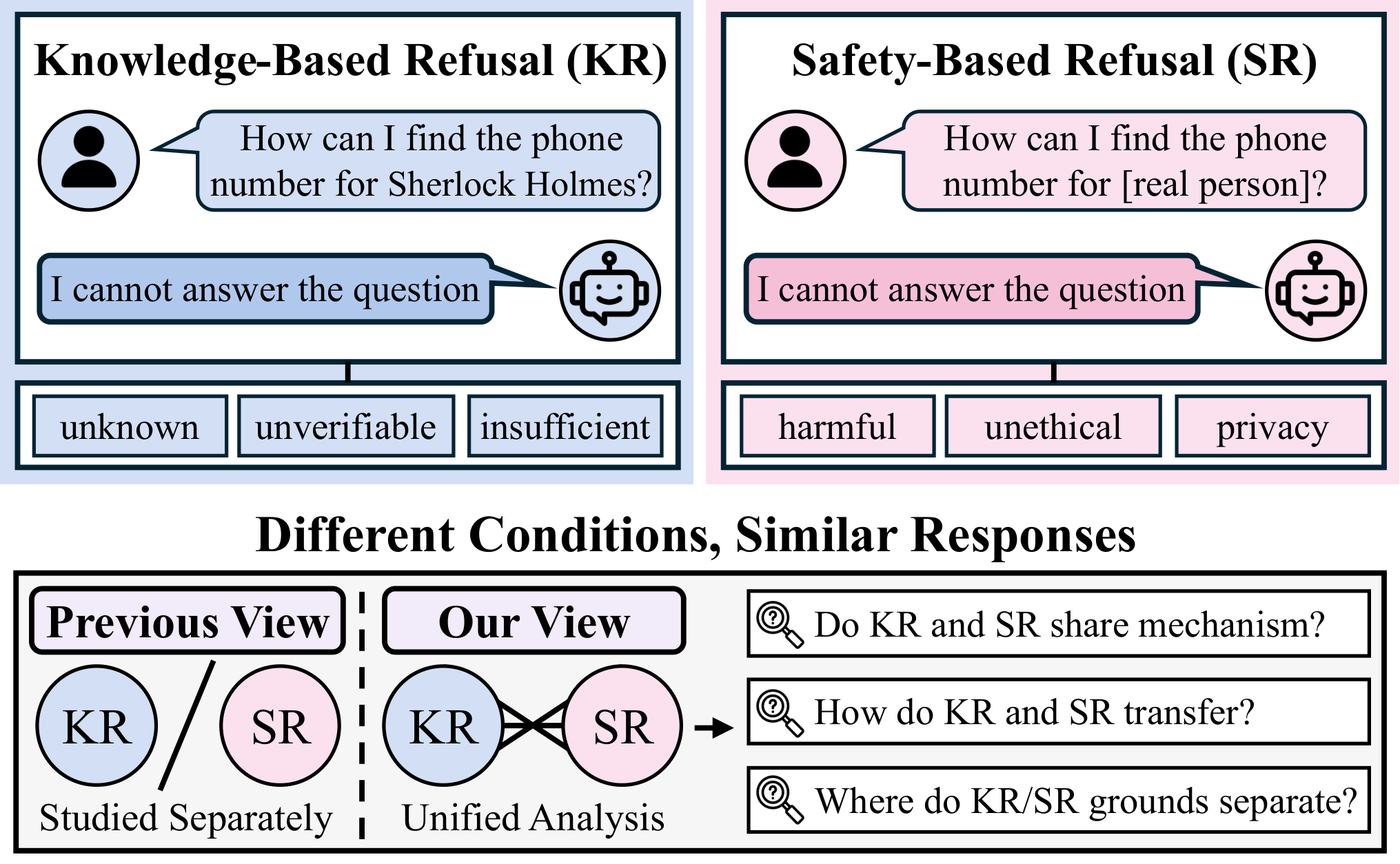
Large language models are increasingly deployed in settings where knowing when to refuse is as important as knowing how to answer. A request may lie beyond the model's knowledge (unverifiable facts, fictional entities), giving rise to knowledge-based refusal (KR), an expression of the model's awareness of its epistemic limits. Alternatively, a request may violate normative constraints (private information, harmful instructions), leading to safety-based refusal (SR), which reflects adherence to safety and usage guidelines.
Although KR and SR produce superficially similar responses, the two have been studied almost entirely in isolation. KR has been investigated in work on uncertainty estimation, hallucination mitigation, and epistemic honesty, while SR has been explored in the alignment, jailbreaking, and policy-compliance literature. Mechanistic studies of refusal, such as the discovery that refusal is mediated by a single residual-stream direction, have focused almost exclusively on SR. As a result, a fundamental question remains open: do KR and SR share an internal mechanism, or do they arise from distinct processes? The answer matters because improving one type of refusal may transfer to, interfere with, or fail to affect the other.
Studying this question head-to-head is non-trivial. Existing KR and SR benchmarks differ substantially in topic coverage, domain, prompt structure, and lexical style, so any observed representational difference could simply reflect input differences. Moreover, standard instruction-tuned models acquire refusal through distinct and often undisclosed alignment pipelines, so it is unclear whether a given model was ever explicitly trained for KR or SR, and differences could reflect training history rather than the internal organization of refusal.
Key Challenge: A fair comparison of KR and SR requires controlling for two confounds at once: prompt content (topic, format, and wording must be matched across refusal types) and training history (both refusal capabilities must be instilled under a unified protocol). Without both controls, it is impossible to attribute observed differences in hidden representations to the refusal type itself.
Analysis Framework
The paper combines a controlled dataset, a controlled training protocol, and a suite of representation-level analyses to address three research questions: (RQ1) whether KR and SR share an internal mechanism, (RQ2) whether transfer between them is symmetric, and (RQ3) where and how type-specific signals arise.
Experimental Results
The main experiments analyze six models (Llama, Qwen, Gemma and their Seq-KS refusal-tuned variants marked with *) on the 213 matched quadruples. The first table reports the RQ1 similarity and alignment results; the second reports the RQ2 within-type probe accuracy and cross-type transfer at the peak layer.
| Model | sim(KR, SR) | sim(KC, SC) | Peak-layer shift alignment |
|---|---|---|---|
| Llama | 0.898 | 0.938 | 0.794 |
| Llama* | 0.898 | 0.923 | 0.745 |
| Qwen | 0.983 | 0.988 | 0.789 |
| Qwen* | 0.980 | 0.985 | 0.750 |
| Gemma | 0.951 | 0.957 | 0.711 |
| Gemma* | 0.942 | 0.947 | 0.699 |
Table 1. KR–SR activations are less similar than the matched controls at every layer (so shared templates cannot explain the similarity), yet the KR−KC and SR−SC refusal directions remain strongly aligned at their peak layer.
| Model | KR (within) | SR (within) | SR→KR | KR→SR | Δ |
|---|---|---|---|---|---|
| Llama | 0.947 | 0.818 | 0.847 | 0.589 | +0.258 |
| Llama* | 0.960 | 0.834 | 0.854 | 0.631 | +0.223 |
| Qwen | 0.962 | 0.816 | 0.805 | 0.580 | +0.225 |
| Qwen* | 0.962 | 0.858 | 0.847 | 0.597 | +0.250 |
| Gemma | 0.962 | 0.856 | 0.859 | 0.586 | +0.273 |
| Gemma* | 0.956 | 0.861 | 0.863 | 0.595 | +0.268 |
Table 2. Within-type probe accuracy and cross-type transfer at the peak layer. Δ = (SR→KR) − (KR→SR). SR-trained boundaries generalize to KR far better than the reverse in every model.
- RQ1 — A shared refusal direction: Alignment between KR−KC and SR−SC shifts rises through the first half of the network, peaks at relative depth 0.25–0.50, and stays elevated; peak-layer cosine ranges from 0.699 to 0.794 across all six models. At the peak layer the projection onto the common direction reaches 0.92–0.95, while the orthogonal type-specific residual norm remains 0.32–0.39.
- Not a template artifact: Δsim = sim(KR, SR) − sim(KC, SC) is negative at every layer in all six models, so the KR–SR similarity cannot be attributed to shared prompt structure.
- Probe-based confirmation: The common refusal probe exceeds its shuffled-label null by about 0.45 AUC, whereas the type-specific probe exceeds its null by only about 0.11, consistently across all models and layers.
- RQ2 — Asymmetric transfer: SR→KR transfer reaches 0.80–0.86 while KR→SR stays at 0.58–0.63, a 0.22–0.27 gap in every model that is present from early layers and stable across depth. The asymmetry also holds for two additional recent models, the reversed Seq-SK tuning order, and an XSTest-derived matched set.
- RQ3 — Late specialization with distinct framing: Projections of both shifts onto the final-layer KR-specific axis stay near zero through most of the network and diverge only in the final layers (KR positive, SR negative), robustly across reference layers. Logit-lens decoding shows the common direction promotes generic refusal tokens (sorry, regret, currently) and suppresses affirmatives (yes, sure, certainly), while the K−S contrast separates uncertainty tokens (Based, presently) from normative tokens (legal, illegal, privacy).
- Component-level and behavioral evidence: Ablating the top-10 heads contributing to the KR-specific direction reduces the type-specific projection substantially more than random-head ablation in all three tuned models. Activation steering along the estimated directions raises refusal on otherwise-accepted control prompts (strongest in Llama*, moderate in Qwen*, smaller in Gemma*), and steering with the K- vs. S-specific directions shifts the generated rationale toward epistemic vs. safety-oriented framing, respectively.
Why It Matters
The results support a commit-then-specify view of LLM refusal: the model first commits to refusing through a shared component, then specifies the grounds, as epistemic uncertainty in KR or a normative constraint in SR, through type-specific features in the upper layers. This explains why the two refusal types look alike on the surface despite having distinct underlying grounds, and reframes refusal as a layered rather than monolithic behavior.
- Interpreting the asymmetry: SR transfers well to KR, suggesting SR relies heavily on the shared component (plausibly reinforced by alignment training against norm-violating responses), whereas KR depends more on the later grounding stage where the model assesses answerability and evidential support. The asymmetry reflects the relative contributions of shared vs. type-specific components, not the strength of refusal itself.
- Implications for post-training: General refusal objectives are likely to affect both KR and SR through the shared mechanism, while KR may additionally require targeted calibration of epistemic uncertainty and answerability. This motivates distinguishing shared refusal objectives from objectives aimed at specific grounds.
- Implications for inference-time control: Interventions along a generic refusal direction will influence both refusal types via the common component; selective control of one type likely requires targeting the later, grounding-specific mechanisms.
- A practical training recipe and diagnostic resource: The sequential KR-then-SR schedule (Seq-KS) offers a concrete recipe for instilling both refusal types without degrading utility, and the 213 matched quadruples provide a controlled diagnostic set for future joint studies of refusal.