One-Line Summary
ESPRESSO introduces adaptive item selection and relevance-based groupwise learning for passage retrieval in conversational recommender systems, achieving up to 35.91% higher Hit@3 than the best of 8 competing methods and significantly improving the factuality of generated recommendation responses.
Background & Motivation
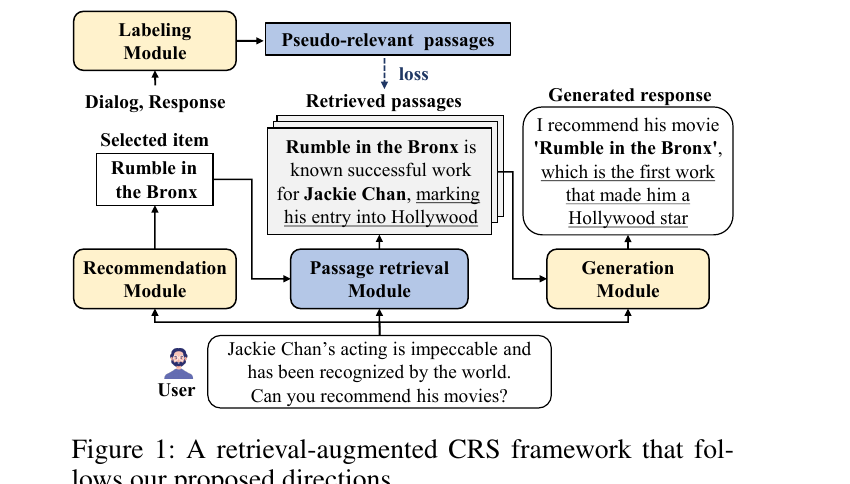
Conversational Recommender Systems (CRS) provide tailored recommendation responses via a chat interface, including both a preferred item and an accompanying explanation. The implementation of CRS consists of two core components: (1) a recommendation module that predicts items a user is likely to prefer, and (2) a generation module that delivers recommendation responses containing not only the recommended item but also an explanation. However, since language models primarily rely on intrinsic knowledge for generating responses, CRS are prone to producing factually incorrect explanations (i.e., hallucinations), particularly when the model lacks sufficient knowledge about the recommended items.
A natural solution is to employ retrieval-augmentation strategies: given a dialog, first retrieve passages describing the features of recommended items, then generate a response grounded in those passages. However, the authors point out that existing passage retrieval methods are insufficient for properly serving CRS in their original forms, because they are neither designed nor trained to retrieve passages that align well with user preferences.
Two Essential Directions for Passage Retrieval in CRS:
- Direction 1 -- Align retrieval with user preferences: The passage retrieval module should utilize the items selected by the recommendation module as additional input. Existing CRS methods typically select a fixed number of items (e.g., only the top-1 item). If this top-1 predicted item does not match the user's actual preference, all retrieved passages will be irrelevant, harming response quality.
- Direction 2 -- Train retrieval with pseudo-relevant labels: CRS datasets do not provide explicit passage-level relevance labels. Manually labeling which passages are relevant requires significant human labor and cost, especially since CRS responses often involve lengthy descriptions. The passage retrieval module should therefore be trained using pseudo-relevant passages determined by an automatic labeling module.
The key insight of this work is that naively following these two directions is insufficient -- the recommendation module can make mistakes (selecting wrong items) and the labeling module can produce noisy labels (mislabeled passages). ESPRESSO is the first work in the CRS domain to propose robust methods that address both sources of error, through adaptive item selection and relevance-based groupwise learning.
Proposed Method
ESPRESSO (Enhanced paSsage retrieval aPpRoach via adaptivE item Selection and relevance-baSed grOupwise learning) operates within a three-module CRS framework, as illustrated in Figure 2 of the paper. The overall process is: (1) the recommendation module predicts user preferences based on the dialog and profile, then adaptively selects items; (2) the passage retrieval module retrieves top-K relevant passages based on the dialog and selected items; (3) the generation module (RALM) produces a recommendation response grounded in the retrieved passages.
Experimental Results
ESPRESSO is evaluated on two CRS datasets: DuRecDial2.0 (a public English CRS dataset with bilingual parallel dialogs) and KoRecDial (a private non-English CRS dataset). Both datasets have human-annotated related knowledge for each response, used as ground-truth relevant passages. ESPRESSO is compared against 8 passage retrieval baselines and 8 response generation baselines.
Passage Retrieval Accuracy (Hit@K)
| Method | DuRecDial2.0 | KoRecDial | ||||
|---|---|---|---|---|---|---|
| H@1 | H@3 | H@5 | H@1 | H@3 | H@5 | |
| BM25 | 0.260 | 0.425 | 0.529 | 0.059 | 0.142 | 0.206 |
| DPR | 0.384 | 0.485 | 0.538 | 0.127 | 0.277 | 0.372 |
| RAG | 0.100 | 0.120 | 0.122 | 0.005 | 0.007 | 0.007 |
| KERS | 0.291 | 0.415 | 0.460 | 0.091 | 0.177 | 0.219 |
| DSI | 0.376 | 0.453 | 0.484 | 0.059 | 0.091 | 0.108 |
| Contriever | 0.393 | 0.497 | 0.550 | 0.123 | 0.278 | 0.371 |
| RankGPT | 0.339 | 0.460 | 0.529 | 0.101 | 0.164 | 0.206 |
| CoT-MAE | 0.406 | 0.504 | 0.561 | 0.134 | 0.283 | 0.392 |
| OURS+DPR | 0.514 | 0.675 | 0.725 | 0.153 | 0.314 | 0.414 |
| OURS+Contriever | 0.520 | 0.685 | 0.735 | 0.141 | 0.313 | 0.423 |
| OURS+CoT-MAE | 0.523 | 0.685 | 0.738 | 0.154 | 0.315 | 0.423 |
Adaptive Item Selection Analysis
The authors analyze how different item selection strategies affect retrieval accuracy, breaking down by whether the top-1 predicted item matches the ground-truth (G=top-1, covering 79.4% of test samples) or not (G!=top-1, 20.6%).
| Selection Method | G=top-1 | G!=top-1 | Overall |
|---|---|---|---|
| S=top-1 (fixed) | 0.815 | 0.003 | 0.648 |
| S=top-N (fixed, N=2) | 0.749 | 0.160 | 0.628 |
| S=top-sigma_conf (adaptive, 70%) | 0.810 | 0.156 | 0.675 |
When the top-1 prediction is correct, using only that item achieves 0.815 Hit@3 -- adding more items introduces noise. When the top-1 is wrong, fixed top-1 selection catastrophically fails (0.003), while expanding the pool helps. The adaptive method achieves near-best accuracy in both scenarios, yielding the highest overall accuracy (0.675) with a 4.2% gain over top-1 and 7.5% over top-N.
Groupwise Learning Strategy Comparison
Three learning strategies are compared as the number of pseudo-relevant passages M varies from 1 to 3: standard contrastive learning (CL), naive groupwise learning (GL, single group of all passages), and relevance-based groupwise learning (RGL, nested subgroups). When M > 1, both grouping methods consistently outperform CL, validating that grouping mitigates mislabeling noise. RGL further outperforms GL by grouping lower-ranked (less reliable) passages only with higher-ranked (more reliable) ones, achieving the best Hit@3 of 0.685 at M=2.
Impact on Response Generation (BLEU Scores)
| Method | DuRecDial2.0 | KoRecDial | ||||
|---|---|---|---|---|---|---|
| BLEU2 | BLEU3 | BLEU4 | BLEU2 | BLEU3 | BLEU4 | |
| GPT2-base | 0.080 | 0.040 | 0.020 | 0.065 | 0.032 | 0.018 |
| BART-large | 0.132 | 0.083 | 0.051 | - | - | - |
| RAG | 0.161 | 0.108 | 0.072 | 0.100 | 0.056 | 0.034 |
| UniMIND | 0.147 | 0.083 | 0.055 | 0.092 | 0.050 | 0.028 |
| LLaMA2 | 0.144 | 0.094 | 0.060 | - | - | - |
| BART(ESPRESSO) | 0.197 | 0.137 | 0.093 | 0.123 | 0.073 | 0.045 |
| LLaMA2(ESPRESSO) | 0.209 | 0.147 | 0.103 | - | - | - |
- Up to 35.91% improvement in passage retrieval: OURS+CoT-MAE outperforms the best baseline (CoT-MAE) by 28.82%/35.91%/31.55% in Hit@1/Hit@3/Hit@5 on DuRecDial2.0 and 14.93%/11.31%/7.91% on KoRecDial.
- Orthogonal enhancement across backbones: Applying ESPRESSO's two core ideas to DPR, Contriever, and CoT-MAE consistently and substantially improves all three, demonstrating that the ideas are backbone-agnostic. For example, OURS+DPR improves DPR by 33.85%/39.18%/34.76% in H@1/H@3/H@5 on DuRecDial2.0.
- Task-specific supervision outperforms GPT-4o: Fine-tuned CoT-MAE outperforms RankGPT (which uses GPT-4o for reranking) by up to 19.76% in Hit@1 on DuRecDial2.0, underscoring that domain-specific training is more effective than zero-shot LLM reranking for CRS passage retrieval.
- Retrieval quality directly drives generation quality: As passage retrieval accuracy increases, response generation BLEU scores improve proportionally. BART(OURS+CoT-MAE) enhances BLEU scores by up to 16.25% compared to BART(CoT-MAE), confirming the tight coupling between retrieval and generation quality.
- ESPRESSO outperforms even larger models: RAG (which leverages retrieved passages) outperforms GPT2-large and LLaMA2 despite having fewer parameters, highlighting that retrieval augmentation is more impactful than model scale alone. BART(ESPRESSO) further outperforms RAG by 22.36%/26.85%/29.17% on DuRecDial2.0.
- GPTEval confirms quality gains: Beyond BLEU scores, GPTEval evaluations demonstrate that ESPRESSO significantly outperforms competitors in informativeness, fluency, and relevance of generated responses, providing a more holistic assessment of response quality.
Why It Matters
As conversational AI becomes more prevalent in e-commerce and content platforms, providing accurate and trustworthy explanations alongside item recommendations is essential for user trust. ESPRESSO makes several important contributions:
- First principled approach to passage retrieval for CRS: ESPRESSO is the first method in the CRS domain to (1) adaptively select a variable number of items from the recommendation module based on confidence scores, and (2) apply groupwise contrastive learning that accounts for relevance ranks. Both ideas are novel contributions to the CRS literature.
- Practical and modular design: The two core ideas are orthogonal to the choice of retrieval backbone -- they can be plugged into any existing neural retrieval model (DPR, Contriever, CoT-MAE) to boost its performance. This makes ESPRESSO a flexible enhancement rather than a replacement, lowering the barrier to adoption.
- Addresses hallucination in recommendation: By grounding CRS responses in retrieved factual passages, ESPRESSO directly tackles the hallucination problem that plagues generative recommendation systems. GPTEval metrics confirm improvements in informativeness, relevance, and fluency.
- No manual annotation required: The automatic labeling pipeline (BM25 candidate selection + GPT-4o semantic reranking) eliminates the need for expensive human annotation of passage relevance, making the approach scalable to new domains and datasets.
- Robust to upstream errors: Both ideas are designed to handle imperfect inputs gracefully -- adaptive item selection handles incorrect top-1 predictions from the recommendation module, and relevance-based groupwise learning handles mislabeled pseudo-relevant passages from the labeling module. This robustness is critical for real-world deployment.